For Mark Bruce, supporting other amputees has always been more than a volunteer role – it’s a passion.
An amputee since losing his leg in a motorcycle accident in 1985, Mark has spent decades giving back to the limb loss community. He became involved with his local Amputee Society in 2008, has served as President of the Canterbury & Westland Amputee Society since 2010, and has held leadership positions with the Amputee Federation of New Zealand, including Vice President and President.
Today, Mark is recognised as a life member of both his local society and the national federation.
But one of his most significant contributions has been helping lay the foundations for what is now the Peer Support Service.
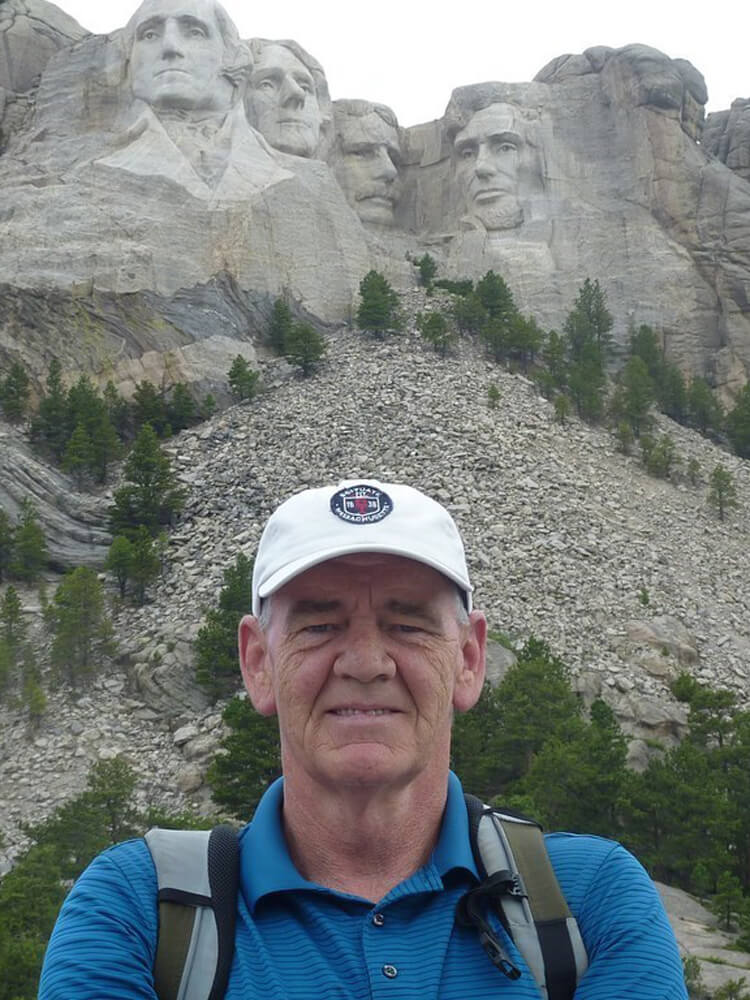
Mark at Mount Rushmore, Dakota, USA
From informal visits to a national service
Before the Peer Support Service existed, support for new amputees often happened through local amputee societies.
“People were doing hospital visits and home visits on a fairly informal basis,” Mark explains. “There was no training. You’d go and see someone, have a cup of tea and a chat, but there wasn’t really any structure around it.”
Mark had been watching developments across the Tasman, where Limbs 4 Life Australia had established a formal peer support programme. Inspired by what he saw, he invited Melissa Noonan, Manager of Limbs 4 Life Australia, to speak at the 2018 Amputee Federation conference in Wellington.
Following the conference, Mark made a phone call to Peke Waihanga Chief Executive Sean Gray. “I asked him, ‘Where are we going to take peer support now?'” The answer was clear: if peer support was going to reach amputees across New Zealand, it needed to become a national service.
Peke Waihanga committed funding to make it happen and appointed Claire Rumble as Project Manager. A working group was formed made up of Peke Waihanga staff including Claire, Ken Te Tau, Kim Moore, and Kathryn Scott, along with Melissa Noonan and Mark. The group met regularly over the following 18 months to design and build the programme.
“Claire did the bulk of the work, with input from all of us,” says Mark. “The service went live in August 2019.”
Claire oversaw the programme in its early months before Matthew Bryson was appointed as Peer Support & Events Coordinator. Under Matt’s leadership, the service continued to grow, expanding its volunteer network and strengthening support for amputees across New Zealand.
The programme quickly exceeded expectations. Mark recalls Melissa once saying that reaching 70 volunteers within five years would be considered a success.
“From memory, within the first year we had around 100 trained volunteers,” said Mark.
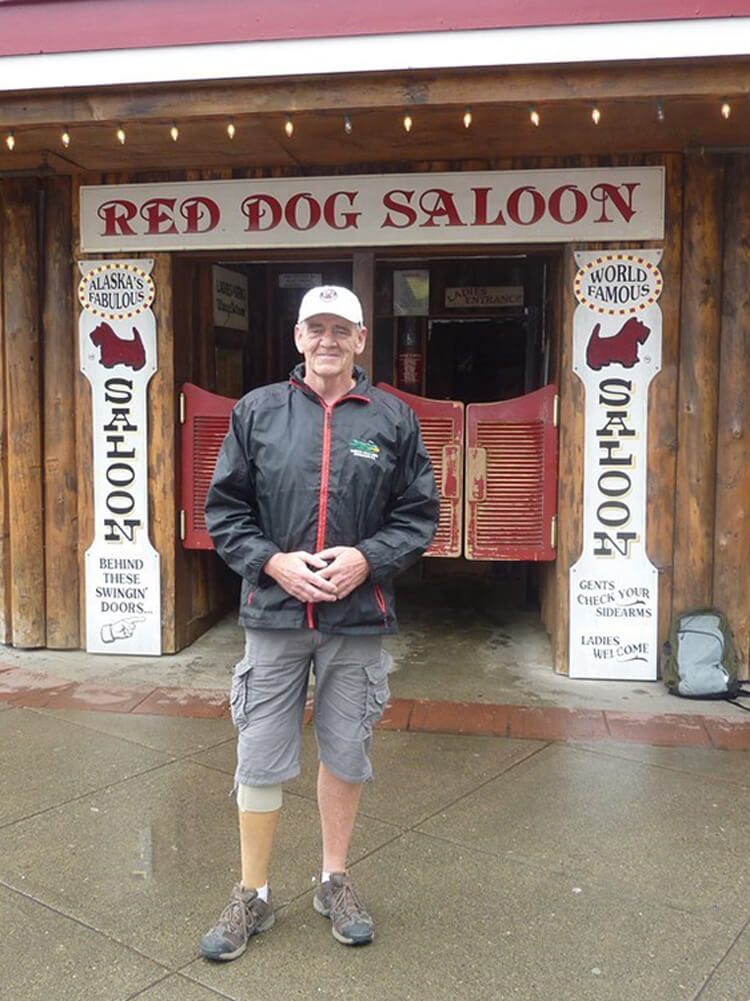
"Losing my leg didn't end my life. It changed it, but it didn't end it." Mark celebrates visiting Alaska, the 50th and final US state on his travel list. "It took a lot of planning, but having an amputation never stopped me from seeing the world."
The power of lived experience
Mark was also part of the first group of trained Peer Support volunteers.
For him, the value of peer support comes down to one thing: lived experience.
“It’s hard to put into words,” he says. “I feel like amputees are part of a big family. I can walk up to an amputee I’ve never met before and introduce myself, and it’s almost like talking to a long-lost friend.”
That shared understanding creates a connection that can’t be replicated.
“A lot of people tell me they feel like their life’s over. I just say, ‘Look at me.’ My life didn’t end. It changed, but it didn’t end.”
While practical advice can be helpful, Mark believes listening is often the most important thing a Peer Support volunteer can do.
“I encourage people to talk to me rather than me giving them a speech about how everything’s going to be okay. I let them express their concerns, their worries and their anger if that’s what they’re feeling.”
He says it’s equally important to acknowledge grief.
“It’s okay to grieve for losing a body part or a limb.”
A service built on connection
More than six years after its launch, the Peer Support Service continues to connect people with trained volunteers who understand the challenges of limb loss because they’ve lived them themselves.
For Mark, that’s exactly what makes it so powerful.
“It’s the lived experience. That’s the key.”